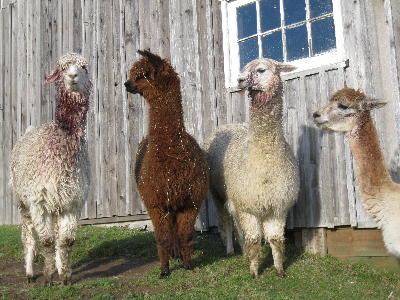
Four of the Welsh's five remaining alpacas stick close together in their pen at their Centralia farm on Friday.
By Sharyn L. Decker
Lewis County Sirens news reporter
CENTRALIA – One of their five remaining alpacas is limping and another is missing an ear.
Greg Welsh describes what remains of his small herd after an attack that left six of his animals dead as scared, ugly and sad.
“They’re traumatized completely,” Welsh said. “They’re skittish around me and they never used to be.”
Greg and Judy Welsh have been raising alpacas at their South Schueber Road home in Centralia about 10 or 11 years. She sells their fiber after they shear the animals once a year.
He says they’re a good tax write off. The couple has an antique store in downtown Centralia so the alpacas are a side business.
The Welsh’s suspect it was dogs that maimed their animals. The Lewis County Sheriff’s Office says it doesn’t know if it was coyotes or domestic dogs.
Lewis County Sheriff’s Office Chief Civil Deputy Stacy Brown said she’s never heard of a livestock attack on this scale in her 15 years on the job.
It was about 5:30 on Tuesday morning, when Greg Welsh woke up to barking and went outside with a flashlight to find his alpacas standing chest deep in a newly rain-made pond. Two dogs at the edge of the water ran off, he said.
Some of the alpacas came out of the pond and just laid down on the ground, he said. As he checked around his farm, he found four others bloodied and dead. He described the scene as total carnage.
“When I looked in the field, there were ears all over, it was disgusting,” he said.
The veterinarian who came out that morning found bites on their noses, heads, flanks and genitalia. The vet, Dr. Robert Remund of Ford Prairie Animal Clinic, euthanized two of them.
He was preparing to put a third alpaca down – the needle was already in its neck – when it stood up, so it got a reprieve.
Remund gave the living animals antibiotics and anti-inflammatory medicine. He said Friday he thinks they’ll survive.
“They should, it all depends on the animal,” Remund said.
Chief Brown said on Friday a Rottweiler that lives nearby was impounded and put in quarantine for 10 days at the animal shelter, but not in connection with the alpaca attack.
It bit Greg Welsh on Wednesday as he was walking by its house, according to Brown.
The Welsh’s suspect the Rottweiler and another dog who lives with it are what ravaged their herd. Judy Welsh said she spotted the pair in their driveway on Wednesday and her husband said he recognized its bark. Brown said there is no proof the neighbor dogs killed the alpacas.
The Rottweiler however, could end up being designated as a dangerous dog, according to Brown.
The Welsh’s are locking their herd in the barn at night now.
They estimate the loss, which included some of their best breeders, at $45,000. Greg Welsh buried them on Thursday.
On Friday, one whitish alpaca – either Abbie or Angel, they still aren’t sure – with matted hair still stained pink on its neck, was on her feet with the others. She’s the one that nearly got put down, the Welsh’s said.
Remund, who’s been treating animals for some 30 years, said encounters like Tuesday’s aren’t entirely unheard of.
“One dog’s not bad, but when you get ’em in a a pack, and alpacas, or llamas or sheep start running around, it becomes sport; it’s not unusual,” Remund said.
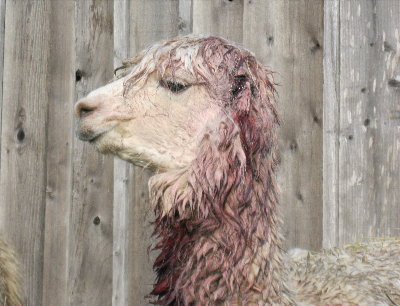
A female alpaca - Abbie or Angel - lost one ear.
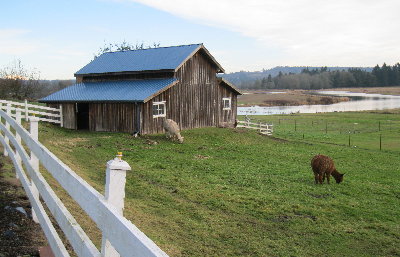
The Schueber Road alpacas stay in their pen during the day but have to be locked up in their barn at night now.

 Join us